QMetry Online and Offline Upgrade Guide for Linux
Note
If you're upgrading to QMetry v8.29.x, update the Automation API to its latest version.
For more information, refer Install/Upgrade Automation API Feature for Online Installations
This guide is for customers who run QMetry containers on Linux using Docker. It describes how to upgrade QMetry from an older version to the latest release. The upgrade also updates Apache Tomcat to version 11.0.5.
The guide provides detailed instructions for backing up the QMetry database, upgrading the application, updating containers, and reconfiguring SSL and installing the Jira add-on.
Prerequisites
Before upgrading, ensure the following:
The MySQL version for both QMetry Reports and the QMetry Application is 8.4.8.
No operations or traffic are running on QMetry.
You have root access to the server that hosts the QMetry containers.
You have enough free disk space in the /opt directory for the database backup.
Additional prerequisites for online upgrade
The server has an internet connection.
Additional prerequisites for offline upgrade
Perform the following steps:
On a machine with internet access, download the Docker images of QMetry products.
Install Docker on the system before executing the Docker commands.
To download the container images, refer to Downloading Docker image of the QMetry Application.
Transfer the downloaded Docker images (.tar files) and the upgrade package
LinuxQMetryAppTomcatUpgrade.zipto the target server.On the target server, restore the Docker images. Refer to Restoring Docker image of the QMetry Application .
QMetry Online and Offline Upgrade Process for Linux
To upgrade QMetry to the latest version, perform the following steps:
Step 1: Backup the Existing QMetry Database
Important
Back up the QMetry database before you upgrade. You need the backup to recover if the upgrade fails.
To backup your existing QMetry database, perform the following steps:
Run the following command to back up the qmetry database. Replace <password> with your MySQL root password and <date> with the current date. The backup is saved in the /opt directory.
docker exec qmetryapp_db sh -c 'exec mysqldump -uroot -p<password> --triggers --routines --hex-blob --single-transaction --lock-tables --no-create-db qmetry' > /opt/qmetry_backup_<date>.sql
Example 20.docker exec qmetryapp_db sh -c 'exec mysqldump -uroot -pqmetry --triggers --routines --hex-blob --single-transaction --lock-tables --no-create-db qmetry' > /opt/qmetry_backup_2023-01-01.sql
Verify that the database is backed up and is available.
Step 2: Download the Required Files
Download the required files by following these steps:
Get the latest version of QMetry Upgrade Installer from the QMetry Support Portal.
Download
QMetry_Linux_Installer.zipto the QMetry Application Server on the host machine.
Step 3: Run the QMetry Upgrade
To run QMetry Upgrade, perform the following steps:
To list the running containers, run the following command:
docker ps
If Docker is not running, run the following command:
docker start qmetryapp_db
docker start qmetry_app_1
Note
Make sure to replace the container names with the appropriate application names as specified in the previous command.
Go to the directory where the zip file is located and unzip the file on the host machine.
unzip QMetry_Linux_Installer.zip
Go to the extracted QMetry directory
cd QMetry_Linux_Installer
Run the following command to grant execution permissions to the upgrade script.
chmod +x upgrade.sh
If your QMetry Version is below 8.9.0.3
Validate the name of your existing container and license volume in the upgrade.sh file before running it.
To validate the name of your existing container and license volume, perform the following steps:
Run the following command to check the Docker volumes' names
docker volume ls
Docker volume name should be qmetry_license.
Run the following command to check the Docker containers' names
docker ps
Docker container name should be qmetry_app_1.
If the names differ, update the upgrade.sh file with the correct values with these steps:
Open upgrade.sh in edit mode.
Run the following command:
vi upgrade.sh
Update the file with the correct volume and container names.
Press i to change the file mode to insert.
Update the variables according to the existing volume and container name.
exist_license_volume → Value from docker volume ls for license
exist_qmetry_container → Value from docker ps for qmetry
Press Esc, and then type:wq to save the changes.
Run the upgrade script:
sh upgrade.sh
The process may take some time to complete. Kindly be patient and allow it to finish properly.
Step 4: Enter the required inputs
The upgrade script asks whether to upgrade online or offline.
Mode of Installation | Prompt | Values | Default | Details |
|---|---|---|---|---|
Linux Online Installation | Do you want to make an online upgrade (Y or N)? | Y,y, N,n | Y | Enter “Y” to begin the online upgrade. |
Linux Offline Installation | Do you want to make an online upgrade (Y or N)? | Y,y, N,n | N | Enter “N” to begin the offline upgrade. |
- | Please enter the directory path of the .tar file for the Docker image | - | - | For offline upgrade, mention the directory path of the .tar file for the Docker image. For example, /opt/qtm |
Step 6: Upgrade Main Menu
Type 2 to upgrade QMetry Application.
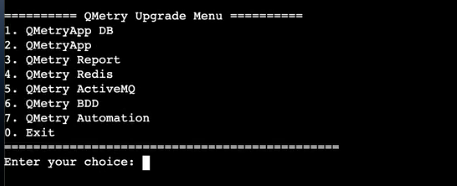
When the upgrade finishes, enter 0 to exit the installer.
Step 5: Verify QMetry Container Status
Run the following command to list the running containers.
docker ps
Step 6: Log in to QMetry
Open the QMetry application in your browser and verify it by logging in.
Step 7: Install or Upgrade QMetry Jira Add-on
Download the correct Jira add-on version that matches your QMetry version. Refer to the table below to find the compatible Jira add-on version based on your QMetry version.
QMetry Version | Jira-addon version required |
|---|---|
8.29.x | 2.4.6_jira10 (Jira Version 10x), 2.4.6 (Jira Version 11x) |
8.28.x | 2.4.5_jira10 (Jira Version 10x), 2.4.5 (Jira Version 11x) |
8.27.0 | 2.4.3_jira10 (Jira Version 10x), 2.4.3 (Jira Version 11x) |
8.26.x | 2.4.2_jira10 (Jira Version 10x), 2.4.2 (Jira Version 11x) |
8.25.x | 2.4.1 (Jira Version 11x), 2.4.1_jira10 (Jira Version 10x) |
For more information on QMetry Jira Integration, refer to Install QMetry App in Jira.
Reconfiguring SSL After Upgrading QMetry to the Latest Version
If you have configured SSL (https) in Tomcat inside the container, you must reconfigure it in the new Docker container.
If you encounter any issues during the upgrade, please submit a support ticket on the Support Portal.